Textile guide · Travel and bedding
Inside the Gingerlily Travel Pillow: Materials, Fill, and Portable Support
A travel pillow has a small footprint and a demanding job: it must be easy to carry, comfortable to rest against, and supportive enough to make a pause away from home feel more settled. Gingerlily travel pillows bring together a mulberry silk outer surface, an inner casing, and a blended fill. Understanding how those layers work together makes it easier to assess their feel, construction, care needs, and role in a journey.
Published November 7, 2026
A smaller pillow, a different set of demands
A bed pillow is designed for a familiar place and a particular sleeping arrangement. A travel pillow has to adapt. It may be packed in a bag, used in a seat, or brought along for a night away. It needs to offer some cushioning without taking up the space or carrying the weight of a full-size pillow. Its design is therefore a study in trade-offs: softness and structure, compactness and useful loft, delicate fabric and practical handling.
The term “travel pillow” covers many shapes and constructions, from supportive neck cushions to compact pillows intended for general rest. The Gingerlily travel pillows described here are small, cushion-style pillows rather than a promise of one universal fit or sleeping position. Their materials explain much of their character: a silk exterior provides a smooth contact surface, while a separate inner casing encloses a filling blend intended to retain cushioning without excessive bulk.
That layered construction is worth noticing. A pillow is not simply its visible fabric or its filling in isolation. The outer surface affects how it feels against the face; the inner casing contains and organizes the fill; and the fill influences loft, resilience, and the pillow’s overall weight. Together, these choices shape what portable support means in practice.
The outer layer: mulberry silk in a travel setting
The travel styles in this collection use 100% mulberry silk for the outer pillow surface, with a stated weight of 19 momme. Momme is a traditional unit used to describe the weight of silk fabric. It can help distinguish lighter and heavier silk constructions, but it is not, by itself, a complete measure of softness, durability, or overall quality. Weave, finishing, construction, and care all matter too.
Silk’s smooth hand gives a pillow a different contact feel from a rougher or more textured fabric. On a journey, when a person may be resting in an unfamiliar seat or room, the surface is a prominent part of the experience. The silk shell also gives the pillow a refined finish, while the compact format keeps it distinct from the larger silk bedding used at home.
Descriptions of silk often emphasize breathability and a cool, smooth touch. These qualities can be relevant to comfort, but they should not be treated as guarantees that a pillow will regulate every sleeper’s temperature or resolve discomfort. Personal comfort depends on many factors, including the surrounding climate, clothing, posture, and individual preference. The most practical way to assess a travel pillow is to consider its dimensions and construction alongside the way it will be used.
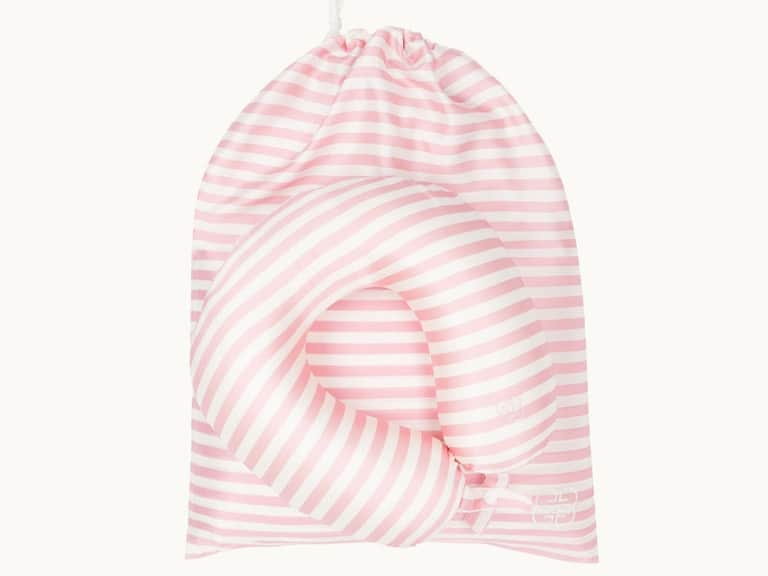
The collection includes different colors and patterns, such as a navy option, a pink-and-ivory stripe, and a seashell design. Those details alter appearance, not the basic purpose of portable cushioning. For a closer look at the construction of each design, see the Silk Travel Pillow - Navy, the Silk Travel Pillow - Pink & Ivory Stripe, and the Silk Travel Pillow Seashells.
Inside the pillow: a blended fill
The travel pillow filling is described as 50% pure long-strand mulberry silk wrapped around a 50% polyester core. The materials have different roles in the overall construction. Silk provides part of the fill, while the polyester core contributes to the pillow’s loft and helps it maintain a compact cushion shape. The blend is intended to balance a soft, lightweight feel with more stable volume than a loose, unstructured filling might provide.
This is not the same construction as a pillow filled entirely with silk. Nor should the shell’s silk content be confused with the make-up of the inner fill. In the travel pillow, the outer surface is identified as mulberry silk, while the interior is a blend. Reading those details separately gives a more accurate picture of what the pillow contains and what to expect from it.
Fill percentage alone does not tell the whole story. How a pillow feels also depends on how much filling is used, how it is distributed, the dimensions of the cushion, and the way the inner casing is sewn. A compact pillow can be comfortable for one traveler and too small, too firm, or too low for another. The stated blend describes materials; it cannot predict every person’s preferred level of support.
For the Navy and pink-and-ivory stripe versions, the inner casing is described as 100% cotton sateen with a 300 thread count. The Seashells version also lists a cotton sateen inner casing at 300 thread count. This separate casing holds the filling, creating a boundary between the fill and the silk exterior. It is a useful construction detail because the pillow has distinct layers rather than a single fabric directly enclosing an undivided mass of filling.
The pillows are described as lightweight and suited to travel, and a cushion pad is included with the Navy and stripe versions. The Seashells description specifies its layered casing and fill. For any particular model, product information and care labels are the best references for included components and handling. In practical terms, the goal is straightforward: a pillow small enough to take along, with enough loft to serve as a cushioned resting surface.
Portable support is about fit, not just softness
Softness is easy to notice, but support is more complicated. A pillow that feels pleasant to touch may not suit every position or setting. When comparing a travel pillow, think about what support means for the trip in question. A person seeking a small surface for a brief rest has different needs from someone looking for a structured neck cushion or a substitute for a full-size bed pillow.
Before choosing, consider a few practical questions:
- Where will it be used? A seat, a train compartment, a guest room, and a hotel bed place different demands on size and shape.
- What kind of support do you want? A compact cushion can provide a soft resting surface, but it is not automatically a neck brace or an ergonomic device.
- How will it be packed? Check the pillow’s dimensions and how much space it will occupy alongside other travel essentials.
- Which surface do you prefer? Silk feels smooth; personal preference for fabric texture is a useful part of the decision.
- How much care can you give it? Delicate textiles need more careful handling than many everyday travel accessories.
A pillow’s portability is not determined only by the word “travel” in its name. It comes from its physical size, weight, resilience, and ease of packing. A compact design may be convenient to carry, but it still needs to fit the traveler’s intended use. Looking at construction details before a trip helps avoid expecting one small cushion to perform every function of a full bed pillow or a specialist neck support.
A closer look at the three travel designs
The Navy Silk Travel Pillow is described as a 19-momme mulberry silk design with a cushion pad included. Its filling combines long-strand mulberry silk with a polyester core, and its inner casing is cotton sateen. The listed care guidance calls for a delicate machine-wash cycle at no more than 30°C, mild detergent, air drying, and a cool iron if needed. Because care directions can vary by item and may be updated, check the label that accompanies the pillow before washing.
The Pink & Ivory Stripe Silk Travel Pillow also uses 19-momme mulberry silk on the outside, with a silk-and-polyester blended fill and cotton sateen inner casing. Its description notes that a cushion pad is included. The colorway is a visual distinction; the practical evaluation remains the same: consider the compact format, the layered construction, and the care information rather than assuming the pattern changes the pillow’s intended use.
The Seashells Silk Travel Pillow is described with a 19-momme mulberry silk outer, subtle rose-pink detailing, and an inner casing made from cotton sateen. Its filling is listed as 50% Grade 6A long-strand mulberry silk wrapped around a 50% polyester core. The closed outer pillowcase and inner casing are described as separate components, emphasizing the layered nature of the design.
Across the styles, the common thread is the combination of a silk contact surface and blended internal fill. The details that vary—color, pattern, and some phrasing around construction—are worth checking at the individual product level. A careful comparison focuses on stated materials and care instructions, not on assuming that similar names mean every specification is identical.
Care: protect the silk, preserve the construction
Silk can retain its appearance and feel when handled appropriately, but it is not a fabric to treat casually. Travel introduces extra risks: a pillow may be compressed in luggage, exposed to spills, or placed on surfaces that are not as clean as a bed at home. A little routine attention—keeping it dry, storing it clean, and following the label—is more useful than relying on broad assumptions about what silk can withstand.
For the Navy travel pillow, the listed guidance is to machine wash on a delicate cycle at a maximum of 30°C, use mild detergent, air dry, and cool iron if needed. The other travel pillow descriptions advise checking their care instructions. Before washing any silk travel pillow, read its attached care label and confirm whether the instructions apply to the removable outer fabric, the inner pillow, or the complete item. The fill and casing may not be intended for the same treatment as the shell.
If a spill occurs, avoid immediately applying heat or aggressive rubbing. Follow the item’s care instructions and, where the stain or construction makes home treatment uncertain, seek advice from a textile-care professional. A pillow with multiple layers can be more complicated to clean than a simple removable cover. Do not assume that a removable-looking surface is designed to come off unless the product information says so.
After use, allow the pillow to air in a dry, ventilated place before packing it away. Avoid leaving silk compressed in damp luggage for extended periods. When carrying it, a clean fabric bag can help separate it from shoes, used clothing, toiletries, or objects with sharp edges. Packing it thoughtfully reduces friction and helps keep the surface from snagging or picking up dirt.
Care is also a question of restraint. The product information for these travel designs does not establish that all versions should be treated identically, so it is better to follow the instructions for the specific pillow than to transfer advice from another silk product. Washing temperature, detergent, drying method, and ironing guidance should come from the relevant label or product care information.
Silk travel pillows and the wider bedding picture
Portable pillows sit at the edge of two worlds: the materials and construction of home bedding, and the practical constraints of travel. A full-size bed pillow can be chosen around a regular sleep position and kept in a stable environment. A travel pillow is designed for occasional, changing settings. The overlap is the attention to fibers, filling, and surface feel; the difference lies in scale and purpose.
That distinction can help set realistic expectations. A travel pillow is not a complete sleep system, and a silk surface does not determine whether a journey will be restful. Seat design, posture, duration, temperature, and the opportunity to move all matter. The pillow’s more modest task is to offer a familiar, portable cushion and a smooth contact surface where one is useful.
Material labels are especially important when comparing silk pillows. One design may use silk as its filling, another may use silk only in the outer fabric, and a third may combine silk with other fibers. The 100% Silk Filled Pillow, for example, is a full-size pillow with long-strand mulberry silk filling and a cotton sateen cover. It serves a different role from the travel models, whose filling is described as a silk-and-polyester blend. Comparing those constructions clarifies why “silk pillow” is not a precise description of every layer.
For anyone interested in textiles, the travel pillow is a compact case study in material choices. The outer fabric, inner casing, and filling each answer a separate design problem. Silk brings a distinctive surface; cotton sateen contains the fill; and the blended core aims to keep a small cushion from losing all its form. The result is not simply silk made smaller, but a layered object designed around the limits and rhythms of travel.
A practical checklist before a trip
Before packing a Gingerlily travel pillow, take a moment to check its condition and the instructions that came with it. Make sure it is fully dry, free of visible marks, and not packed alongside anything likely to catch or stain the silk. If the pillow has been stored for a while, airing it in a clean, dry space can help it feel ready for use. Avoid placing heavy objects on top of it for long periods, particularly if you want to preserve its shape.
- Confirm the specific model’s materials and care instructions.
- Check whether a cushion pad is included and how the components are arranged.
- Choose a clean bag or compartment that keeps the pillow separate from rough or damp items.
- Plan for where the pillow will be used; a compact travel cushion is not necessarily a substitute for neck-specific support.
- After the journey, let the pillow air before storing it in a dry place.
These steps are simple, but they reflect the central principle of caring for delicate textiles: use is not the problem; careless handling is. A travel pillow is meant to travel. Protecting its surface and respecting its care instructions helps make that purpose compatible with the requirements of silk.
The value of knowing what is inside
The phrase “silk travel pillow” can suggest an object made entirely from one fiber. In this case, the construction is more specific: mulberry silk on the outside, cotton sateen as the inner casing, and a blend of silk and polyester in the fill. That arrangement is not a contradiction. It is a layered design in which each material has a distinct place.
For the traveler, those details make the pillow easier to evaluate. The silk surface describes the feel against the face. The blended filling gives context for the cushion’s loft and shape. The inner casing explains how the filling is contained. Care guidance identifies the handling needed to keep the textile in good condition. Together, these facts offer a more dependable picture than a single label or a broad claim about comfort.
A portable pillow cannot make every seat comfortable or guarantee sleep on the move. It can, however, bring a small measure of familiarity to an unfamiliar setting. Gingerlily’s travel pillows approach that task through a compact cushion format and a carefully layered material combination. For readers comparing silk travel pillows, the most useful questions are not only how soft a surface feels, but how the pillow is built, what kind of support it is intended to provide, and how it should be cared for when the journey ends.
Key takeaways
- The travel pillows use a 19-momme mulberry silk outer surface, with model-specific colors and patterns.
- The described filling blends silk with a polyester core; the inner casing is cotton sateen.
- Portable support depends on dimensions, fill, construction, and intended use—not softness alone.
- Check the specific care label before cleaning, and protect silk from damp storage, rough contact, and unnecessary heat.